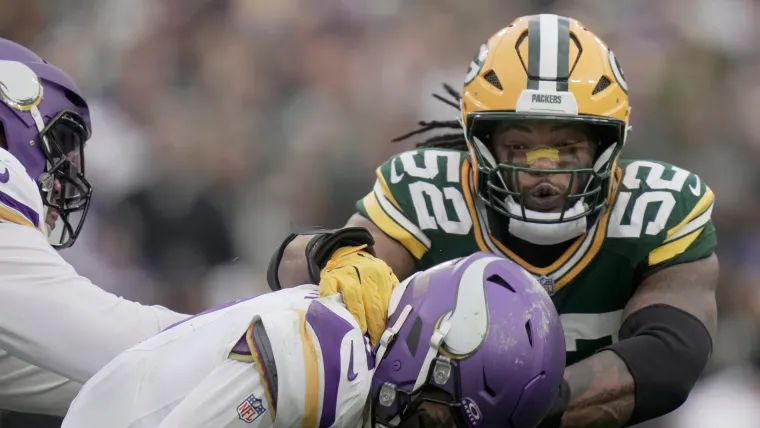
Packers' Rashan Gary Farewell: Navigating High Expectations and Production Dips
The Green Bay Packers community is buzzing with the surprising news of Rashan Gary's departure, a development the edge rusher himself initially announced on social media before quickly deleting the post. This abrupt
rashan gary farewell marks the end of an era for the former 2019 first-round pick, who had become the team's longest-tenured player. While the specific mechanism of his exit—whether a trade or release—remains to be officially clarified, the message is clear: Gary is moving on. This decision, impactful for both player and team, underscores the harsh realities of the NFL's business side, particularly when a high-value contract meets a noticeable dip in on-field production.
The $96 Million Bet: Contract vs. Cap Strain
Gary's significant four-year, $96 million contract, inked during the 2023 season, stands as a testament to the Packers' belief in his potential and past performance. With two seasons still remaining on that deal, his departure creates immediate financial implications for Green Bay. According to Over the Cap, moving on from Gary is projected to free up approximately $11 million in cap space for the upcoming season. This relief is crucial, especially considering Gary's towering $28 million cap number, which was the second-highest on the team, trailing only quarterback Jordan Love.
Such substantial contracts are commonplace in the NFL for elite pass rushers, but they also carry inherent risks. Teams invest heavily, betting on sustained performance. For the Packers, the timing of this deal, coming after Gary's breakout 2021 season and before his 2022 ACL injury, highlighted his perceived value. However, as the league year approaches and teams finalize their rosters, financial flexibility often dictates tough choices. The decision to part ways, despite the accelerating dead money of just over $17 million onto the cap, indicates that the projected cap savings and the desire to reallocate resources ultimately outweighed the investment in Gary. For Green Bay, this move is less about penalizing a player and more about optimizing their salary structure to build a competitive roster for the future.
A Tale of Two Seasons: The Striking Production Disparity
The core of the Packers' decision seems rooted in Rashan Gary's highly inconsistent performance during the last season, presenting a stark contrast between his early and late-season contributions. Through the first eight weeks, Gary was nothing short of dominant. He amassed an impressive 7.5 sacks and tied for 11th in the league with seven tackles for loss, ranking fifth overall in the NFL in terms of impact plays. This initial burst of production was exactly what the Packers had envisioned when they awarded him his lucrative extension.
However, the narrative took a dramatic turn in the latter half of the season. From Weeks 10 through 18, Gary's production virtually evaporated. He registered no sacks, an alarming statistic given that 325 other players across the league managed to record at least one. Similarly, he failed to register a single tackle for loss during that period, while over 500 different players did. This significant drop-off was particularly concerning for an edge rusher who, as the 13th-highest-paid at his position, also ranked a mere 39th in pressure percentage among players with at least 100 pass-rush snaps. What makes this decline even more puzzling is that Gary was not on the injury report at any point during the season, suggesting the dip wasn't a direct result of a new physical ailment. While the 2022 ACL tear undoubtedly impacted his recovery and ability to return to his elite form, the late-season slump without a reported injury presented a complex problem for the coaching staff and front office.
Packers' Justification vs. Hard Realities
Despite the clear statistical decline, Rashan Gary found support from key figures within the Packers organization, at least publicly. General Manager Brian Gutekunst, Head Coach Matt LaFleur, and former Defensive Coordinator Jeff Hafley all voiced their defense of Gary's impact. Gutekunst, at the NFL combine, acknowledged Gary's ability to create "60 pressures, 7.5 sacks" and emphasized that such production is "tough to replace." He further expressed an expectation for Gary to play "at that level or higher" if he returned, highlighting the talent he possesses. LaFleur even offered a somewhat peculiar justification, noting Gary was "never a high snap-count guy," perhaps an attempt to frame his workload.
Yet, despite these public endorsements, the underlying reality of his contract versus his late-season output seems to have been the deciding factor. NFL teams, while valuing talent, must constantly evaluate return on investment. The disconnect between a $24 million annual salary and a prolonged stretch of minimal impact, especially when the team needed consistent pressure, became untenable. This situation illustrates a crucial aspect of NFL team management: the difficult balance between player loyalty, coaching rhetoric, and the pragmatic financial and performance metrics that drive roster decisions. Ultimately, the Packers appear to have concluded that Gary's recent play simply wasn't aligning with his substantial price tag, pushing them to make a move that would provide greater cap flexibility and opportunity for other players. For a deeper dive into the financial implications, read
Rashan Gary Departs Packers: Unpacking the $11M Cap Relief.
The Future of Green Bay's Edge Rush: Who Steps Up?
With Rashan Gary's departure, the Green Bay Packers' edge rusher room faces significant changes and a clear demand for new leaders to emerge. The immediate spotlight falls on Micah Parsons, though his recovery from an ACL tear in December could see him miss the first month of the upcoming season. His health and readiness will be paramount. Alongside him is Lukas Van Ness, the 2023 first-round pick, who now has an accelerated path to a more prominent role. His development, particularly in creating consistent pressure and setting the edge, will be crucial for Green Bay's defensive scheme.
Beyond these two, the depth chart includes young talents like Barryn Sorrell and Collin Oliver, who will now have increased opportunities to prove their worth. The team also needs to consider the statuses of Kingsley Enagbare, who is set to hit unrestricted free agency, and Brenton Cox Jr., a restricted free agent. The Packers will likely explore options in both the NFL Draft and free agency to bolster this critical position group. The challenge will be to replace Gary's early-season burst and overall talent, even if his consistency faltered. For fans, understanding
What Rashan Gary's Exit Means for Green Bay's Edge Rusher Future is essential. The success of the defense hinges significantly on the ability of the remaining and incoming edge rushers to generate pressure and disrupt opposing offenses, ensuring that the team remains a contender in the NFC.
Conclusion
The
L
About the Author
Staff Writer & Rashan Gary Farewell Specialist
Linda is a contributing writer at Rashan Gary Farewell with a focus on Rashan Gary Farewell. Through in-depth research and expert analysis, Linda delivers informative content to help readers stay informed.
About Me →